Your eyeglass prescription contains all the information needed to make your lenses — but the abbreviations can look like a foreign language. Here is what everything means.
The Two Eyes: OD and OS
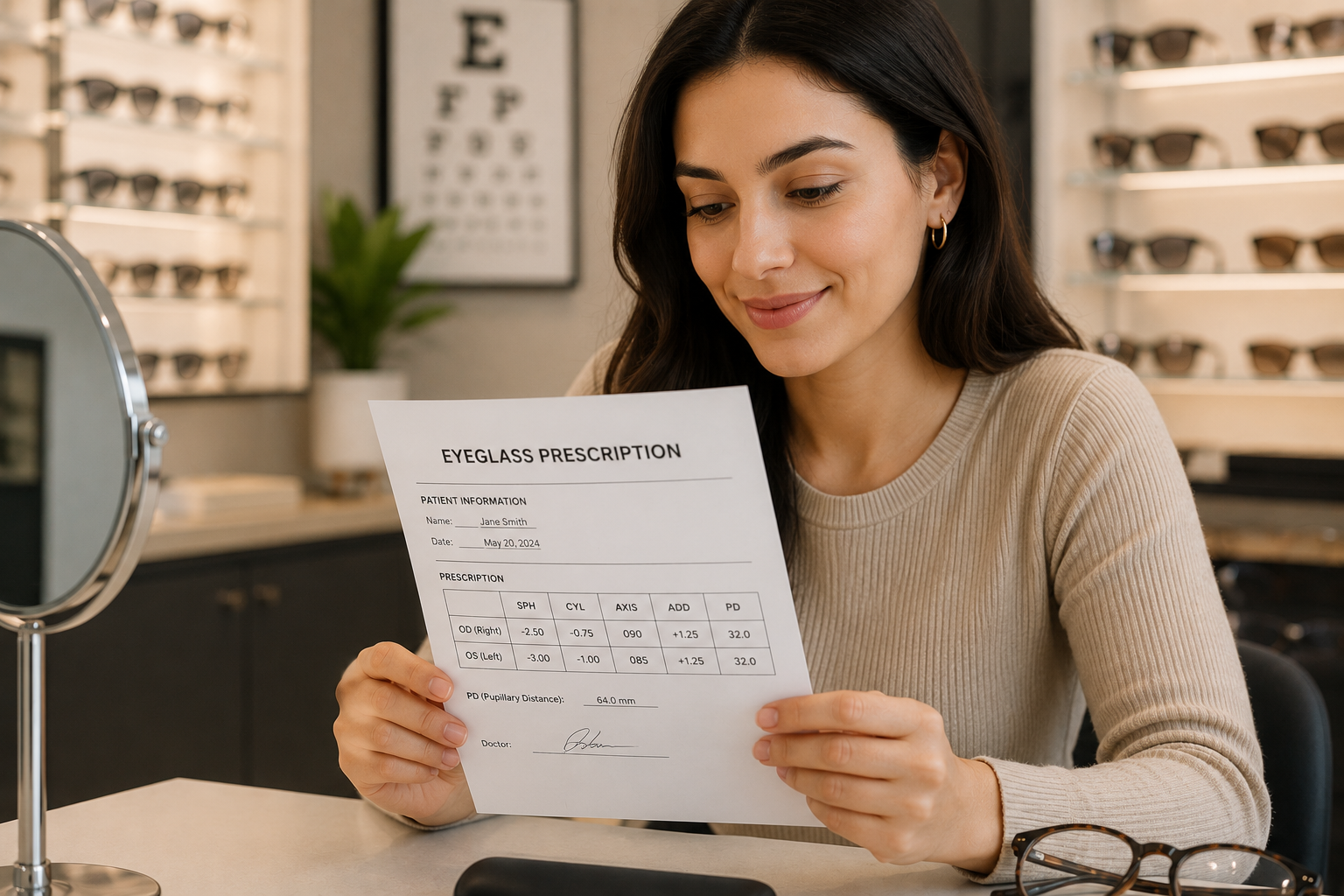
OD (Oculus Dexter) means right eye. OS (Oculus Sinister) means left eye. Some prescriptions also use OU (Oculus Uterque) for both eyes together.
SPH — Sphere
This is the main correction strength. A minus (–) value means you are short-sighted (myopic) and need help seeing far. A plus (+) value means you are long-sighted (hyperopic) and may struggle to see near objects clearly.
For example, -2.50 means moderate short-sightedness. +1.25 means mild long-sightedness.
CYL — Cylinder
This number corrects astigmatism — when the eye is shaped more like a rugby ball than a football, causing blurred or distorted vision. It can be plus or minus, and may be absent from your prescription if you have no astigmatism.
AXIS
If you have a CYL value, you will also have an AXIS. This is a number from 1 to 180 degrees that tells the lens maker at what angle the cylinder power should be placed. It has no power itself — it just gives direction.
ADD — Addition
This value appears in bifocal or progressive prescriptions. It is always a plus value and represents the extra magnification needed for reading (near vision). If your prescription has an ADD value, you likely need reading glasses or progressives.
PD — Pupillary Distance
PD is the distance in millimetres between your two pupils. It is essential for centering lenses correctly in your frame. It may be listed as a single number (binocular PD) or two numbers (right eye / left eye monocular PDs).
Always keep a copy of your prescription. At Spectica, we give you a printed prescription after every eye test — free of charge.
Sample Prescription Explained
Here is how to read a typical prescription:
- OD: -1.75 / -0.50 × 180 — Right eye, short-sighted, with mild astigmatism at 180 degrees
- OS: -2.00 / -0.25 × 90 — Left eye, slightly more short-sighted, with very mild astigmatism
- ADD: +1.50 — Reading addition for progressive or bifocal lenses
- PD: 32.5 / 32.0 — Right PD 32.5mm, Left PD 32.0mm
When to Update Your Prescription
Adults should have their eyes tested every 1–2 years. Children should be tested annually as their prescription can change rapidly during school years. If you notice your vision has changed — book an appointment rather than waiting for your next routine check.